
The woman lived in a large homeless encampment in Spokane, Washington. One winter night, others there tried to burn her out of her tent.
She suffered third-degree burns on her arms, wandered away, and collapsed into a snowbank. After four days and three nights outside, somebody found her. Rescuers took her to Providence Sacred Heart Medical Center, where, because of frostbite, doctors had to amputate her feet and hands.
The woman was in the hospital, part of Providence St. Joseph Health, for nine months. Social workers at the hospital got in touch with LouAnn Himel, a social worker with Catholic Charities Eastern Washington, who works closely with the hospital as part of its Stable Placements program to help long-term patients get settled outside of the hospital.
Although hospital social workers had warned Himel that the woman didn’t trust others easily, Himel said the woman welcomed the help. "She was gracious," Himel said. "She was so grateful to be alive. She was so grateful to have any kind of support that we could offer."
Wraparound support
The Stable Placements partnership began in 2020. Providence Sacred Heart leaders reached out to Catholic Charities, a longtime partner, to see if the agency could help support select patients after weeks- or months-long hospital stays. Many had complex medical and behavioral health concerns even before their stays, and many were homeless, had dementia, or both.
All the social workers wanted to make sure the patients got wraparound support, such as with housing, medication, transportation, and mobility needs, to help avoid a situation that would get them readmitted.
"We don’t follow people outside the hospital," said Staci Wright, one of two Providence Sacred Heart social workers who focus on patients with extended stays. "It really helps to have eyes on the outside."
Wright added that if a piece of medical equipment or a medication doesn’t arrive after discharge, or if some other detail isn’t quite right, Himel or Catholic Charities social worker Troy LeBlanc will call, and together they will figure out a solution.
In Washington state, homeless adults often are placed in "adult family homes," private residences with about five residents and a caregiver. The social workers try to ensure that the home is the right fit and there’s clear communication with the caregiver.
"Before this program, we were having a lot of people just walk away from the home and they’d come back to the ER," Wright said. "We’d just continually have to redo the same thing every six months."
Since its inception, Stable Placements has served 138 clients.
"Grind it out"
Behavioral health challenges and access to care, mental health issues and substance use, and homelessness and housing instability were the top needs identified in the 2024 Providence Spokane community health needs assessment.
The assessment showed a shortage of affordable housing and that older adults — many of whom were priced out of their homes or have lost a spouse — make up the largest increase in the homeless population. Wright says the hospital also sees an increasing number of older people using illegal drugs.
David Sackmann, vice president of stabilization services for Catholic Charities Eastern Washington, said homelessness and fentanyl overdose numbers have trended down in Spokane in the last couple years but not as quickly as he would like. In the needs assessment, increased fentanyl use and deaths had been cited as a concern.
The only criteria for acceptance in Stable Placements is the client must live in Spokane County upon hospital discharge and be referred from a hospital social worker.
Sackmann said that the problems these patients face are complex, and he’s grateful that, unlike some other social service programs, Stable Placements has no restrictions on the amount of time Catholic Charities can spend working with someone.
"When we have these complicated issues, we have to grind it out and see it through," he said. "I think that’s a huge factor in being successful."
He recalled a man the agency started working with in 2023. The man had 51 hospitalizations that year. In 2024, he had 23 hospital visits. In 2025, he had four. Sackmann attributed the improvement to the agency’s continued support for him.
Three other clients who had 126, 192 and 183 hospital visits in 2024 had none the following year, Sackmann said.
In fact, most Stable Placements clients did not return to long hospital stays, and 92% were able to maintain their housing placement after discharge.
"It’s an absolute honor and a privilege to help our clients," Himel said. "They’re amazing. They’ve just been dealt a really bad deck of cards in their life."
A gift of thanks
Stable Placements is just one example of Providence Sacred Heart partnering with Catholic Charities. The two have worked together to build St. Anne’s Children and Family Center to help low-wage hospital staffers access child care; the House of Charity Clinic, the oldest and first free medical clinic in the state; and the House of Charity homeless respite program, which has been replicated nationwide and was the 2016 recipient of the CHA Achievement Citation Award.
Himel and LeBlanc are longtime social workers and have been part of Stable Placements for a few years. They are familiar with the people who run care homes and usually can help make a good match.
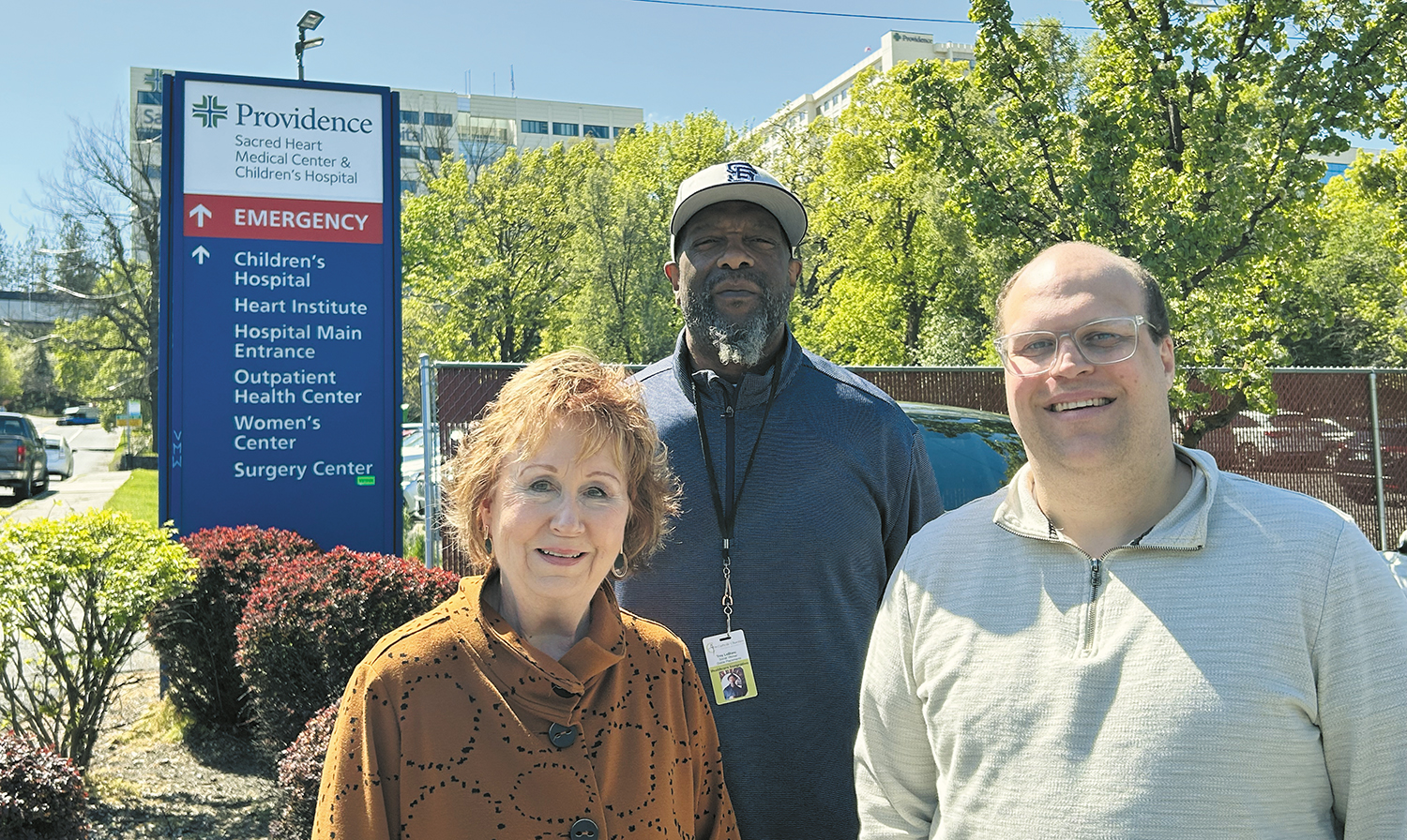
LeBlanc said they do their best to build relationships with clients, and will bring goodies to cheer them up, noting one woman in particular who is calmed by a good cup of coffee.
"I think we do a great job of listening, just holding conversation. I think that gets us a long way, that constant, consistent presence that we provide," he said. "They begin to trust us, and as a result, they’re more interactive and more prone to tell us what’s going on, so that we can address the problems as they come about."
Sackmann attributes much of the success of the program to Himel and LeBlanc being "very mission aligned, very wonderful people. I try to make excuses to have more and more meetings with them," he joked.
As for the woman who had to have her hands and feet amputated, when Himel visited her in the hospital, she noticed a dried-up bouquet of flowers in the window. The three Providence Sacred Heart surgeons who operated on the woman sent them.
"Do you think you can help me with one thing?" the woman asked Himel. "Can you help me get them a bouquet of flowers? I’m so grateful they saved my life."
Himel arranged to have flowers sent to the surgeons. Now, the woman is thriving in a care home.
"We visit her frequently, not as frequently as we used to, because we don’t have to," Himel said. "It’s such a happy-ending story."