
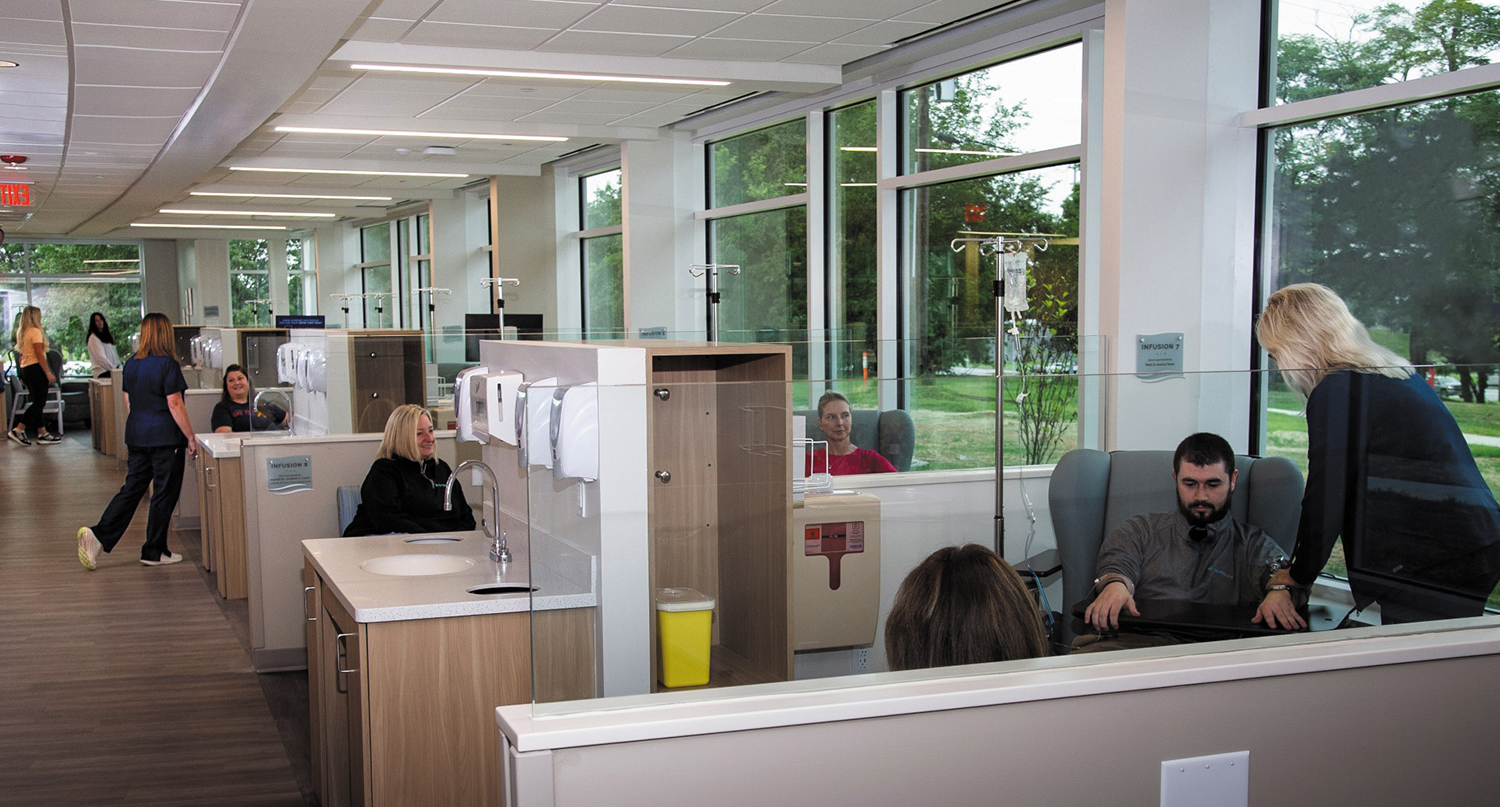
Despite being in a city of less than 30,000 and serving a sprawling rural region, the staff at the Mercy Health — Paducah Cancer Center in Kentucky pride themselves on offering a quality of care and wraparound services that would do big-city cancer centers proud.

John Montville, executive director of the oncology service line at Mercy Health — Lourdes Hospital, says the cancer center not only has a state-of-the-art facility and follows the most up-to-date treatment protocols, it “emphasizes holistic cancer care, treating both the disease and the individual.”
As part of its whole-person care, Montville says the cancer center provides “ancillary and integrative care as essential components of its overall program.” That supportive care includes navigation through the center’s services by an experienced nurse and assistance from social workers to address needs such as lack of transportation and food insecurity.
“High-quality cancer care should be a given for all cancer patients. The additional support they need, beyond high-quality care, should also be a given,” Montville says. “We built this program around the patient.”
Ready to treat and support
The cancer center is a department of Mercy Health — Lourdes Hospital, a 379-bed facility that is part of Bon Secours Mercy Health. The hospital serves Western Kentucky, Southern Illinois, Southeast Missouri and Northwest Tennessee.
While the cancer program at the hospital goes back to 2018, the center is much newer. The 19,000-square-foot facility opened in 2024. It houses:
- A medical practice with space for three medical oncologists/hematologists and three advanced practice providers
- 21 exam rooms and one procedure room
- A 22-bay infusion center with flexible configurations
- An oncology pharmacy and laboratory
- A prayer and meditation room

The center also has space and staff to provide various supportive services, such as access to Amber Newsome, an oncology nurse navigator. Newsome joined the center in that role last year after several years as a nurse.
Her interest in oncology began early. As a student, she participated in the Oncology Nursing Society. After graduation, she spent time in respiratory and surgical nursing. Through it all, she says she maintained an interest in oncology.
Newsome says her experience enables her to distinguish between symptoms related to cancer treatments and those that aren’t.
As a nurse navigator, she tries to meet patients during their initial consultation. She explains to them that her role is to identify their needs and ensure they get appropriate scheduling for services and provider appointments.
Meeting social needs
Another member of the cancer center’s supportive care team is Sarah Carter, a clinical oncology social worker. Her experience includes five years with Mercy Hospice working with families and children.
She was the first social worker to join the Mercy oncology team. “The experience gained in hospice care has been invaluable for oncology — helping patients through the challenges of diagnosis, treatment and life changes that follow cancer,” she says.
The cancer center does what Carter calls “distress screening” as part of a biopsychosocial and spiritual assessment of patients. The screenings help the care team connect patients with needed resources, even outside of the medical.
The social support the center’s team provides helps ensure patients can access care, such as transportation and financial help, and meet personal needs, such as clothing purchases and home fumigation. Funding to cover expenses that are not met elsewhere and not reimbursable often comes from the Mercy Health Foundation.
“Surviving cancer brings its own struggles, including anxiety, depression and shifts in identity,” Carter said. “Support systems often change, and many patients face ongoing fears, especially before follow-up scans.”
Along with helping patients access needed resources, Carter works to help them express themselves and to generally ease their burdens.
Accessing complex resources
The cancer center’s supportive services also provide every patient access to palliative care and to an oncology financial navigator. Montville says studies of cancer patients have shown that finances are the number one concern for cancer patients, of even higher concern than fear of death.
The oncology financial navigator assists patients in understanding their insurance coverage, estimating out-of-pocket expenses, and accessing valuable support programs, such as medication assistance from pharmaceutical companies.
“Only trained professionals in this role can effectively guide patients through these complex resources,” he said.
Montville says the cancer center’s wraparound care is an embodiment of the Bon Secours Mercy Health mission to extend compassionate care to all, “especially people who are poor, dying and underserved.”
“This is so illustrative of getting these support services into the hands of those who need it most,” he says. “The poor need more services to support them beyond just their care — from food insecurity to transportation assistance to financial navigation.”