
By JULIE MINDA
Coalition working to address some of the issues raised in demonstrations
Bon Secours Hospital is just about two miles from an intersection in West Baltimore where protesters took to the streets in April and May in reaction to the death of a black man allegedly catastrophically injured while being arrested and transported by Baltimore city police. (The hospital treated some community members injured in the protests.)

Many commenters lamenting the death of Freddie Gray, 25, have decried the poor socioeconomic conditions that prevail in West Baltimore. For several years, Bon Secours Hospital and its partners in the West Baltimore Primary Care Access Collaborative have been chipping away at some of those socioeconomic issues and at the related health care disparity in West Baltimore. They've been increasing the number of primary care providers, helping community members more effectively access health care, improving coordination among care providers and offering preventive services to help people better their cardiovascular health.
While the challenges are daunting, there is power in numbers. "The greatest benefit (of the coalition's work) has been the opportunity to have 15 institutions aligned in purpose to address health disparities in the West Baltimore community," explained Dr. Samuel Ross, chief executive of Bon Secours Baltimore Health System, which includes the 88-bed Bon Secours Hospital and a network of ambulatory and community services. "Together, we can do so much more for care coordination and address high utilizers (of health care services) that are common to our systems."
Spearheaded by Bon Secours Hospital in 2010 and made up of health systems and hospitals, federally qualified health centers, universities and other partners, the West Baltimore Primary Care Access Collaborative is the subject of an Innovation Forum at the Catholic Health Assembly, June 7-9, in Washington, D.C. Ross and co-presenter Novella Tascoe will describe the collaborative' s approach to increasing primary care access and bettering health outcomes in a session titled "Using Collaboratives and Population Health Strategies to Improve the Health of Communities." Tascoe is the former executive director of community health services for Bon Secours Baltimore Health System.
Countless concerns
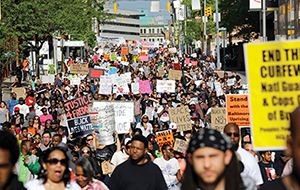
Image credit: Patrick Semansky/Associated Press
Four zip codes make up the West Baltimore Health Enterprise Zone, and within that zone are neighborhoods now gaining national attention with the Gray protests. Joy Twesigye directs the West Baltimore Health Enterprise Zone — also known as the West Baltimore Community Access Resources Exchange — for the coalition. "The residents we serve live in the area of the recent protests," said Twesigye.
The West Baltimore Health Enterprise Zone has deep-seated socioeconomic challenges. The zone has "the highest disease burden and worst indicators of social determinants of health" when compared with almost every other community in Maryland, according to information from the coalition.
Compared with the broader city of Baltimore and the state, West Baltimore has the highest percentage of preventable emergency department visits and the worst rates of asthma, diabetes, cardiovascular disease and chronic obstructive pulmonary disease, according to community needs assessments. In some cases, West Baltimore's disease rates are double or triple those of the city and state.
Twesigye said the coalition's programs are meant to address these health care disparities.
Better access to providers
The federal Health Resources and Services Administration has designated West Baltimore as a medically underserved area based largely on its lack of primary care providers and poor health outcomes.
The coalition is using a portion of its Health Enterprise Zone grant to recruit physicians, physician assistants and other primary caregivers, in part by making clinicians aware of state loan repayment and tax credit programs and other incentives to serve in the zone. So far, the coalition partners have attracted more than two dozen primary care providers.
To increase the number of entry-level primary care and other providers, the coalition is offering scholarships of up to $8,000 to West Baltimore community members so they can pursue certificates and other education related to health care jobs.
Chanda Sawyer, 39, is among the 29 West Baltimore residents who have received such scholarships so far. A medical assistant in a pediatrician's office, she used her scholarship to earn a patient care technician certificate that will pave the way for her to apply for a position in a hospital, where there is opportunity for career advancement. In time she wants to study to become a nurse. She said, "This was important for me because this came at a time when I didn't have the money to go back to school."
Out in the community


Patrick O'Neil, one of the community health workers, works with patients in Bon Secours' emergency department. He helps hospital patients understand and follow discharge instructions. "I want to empower these patients so that they know exactly what changes need to be made in their lives in order to achieve optimal health," he said.
O'Neil also helps schedule medical appointments, points patients to help with paying for their utilities and serves as an informal life coach. "The greatest challenge for me is how deeply entrenched some of the issues patients face truly are within this community," he said. "It can be very overwhelming to see what he or she is stacked up against."
Care coordination
Twesigye said West Baltimore's access problem has to do not just with a lack of providers but also with the fact that there had been poor communication — and a poor referral system — among existing providers, as well as a lack of understanding of the primary care system by community members.

A by-product of the coalition's work together is that they've learned to communicate better with one another and have built connections, so that they now regularly refer patients to one another. The community health workers play a key role in this care coordination, as they educate community members about the system and help them access coalition providers.
Heart health
While the West Baltimore Primary Care Access Collaborative's efforts are a work in progress, and the full impact has yet to be realized and measured, Ross said the coalition's progress can serve as inspiration for other ministry systems and facilities. He advised, "Believe in the possibilities and always be guided by the mission and the needs of the people."
Partners in the West Baltimore Primary Care Access Collaborative
|
Bon Secours responds to West Baltimore community During protests surrounding the death of Freddie Gray, 25, community members surfaced concerns about poor socioeconomic conditions around West Baltimore. Bon Secours Health System of Marriottsville, Md., responded by providing funds to bolster existing efforts of Bon Secours Baltimore Health System to address health disparity and social determinants of health in West Baltimore. The regional system is tackling such concerns both through the West Baltimore Primary Care Access Collaborative and through community benefit initiatives. In a message sent to Bon Secours Baltimore, leaders of the parent system's mission fund wrote, "All of Bon Secours stands in solidarity with the Baltimore system and the people of Baltimore during this turbulent time. … While the rioting has calmed, Baltimore is in even greater need of our support to address deep-rooted problems …. The Mission Fund is dedicating $50,000 to the Baltimore Health System to support continuing efforts in the community aimed at addressing the unmet needs of individuals and families." |