
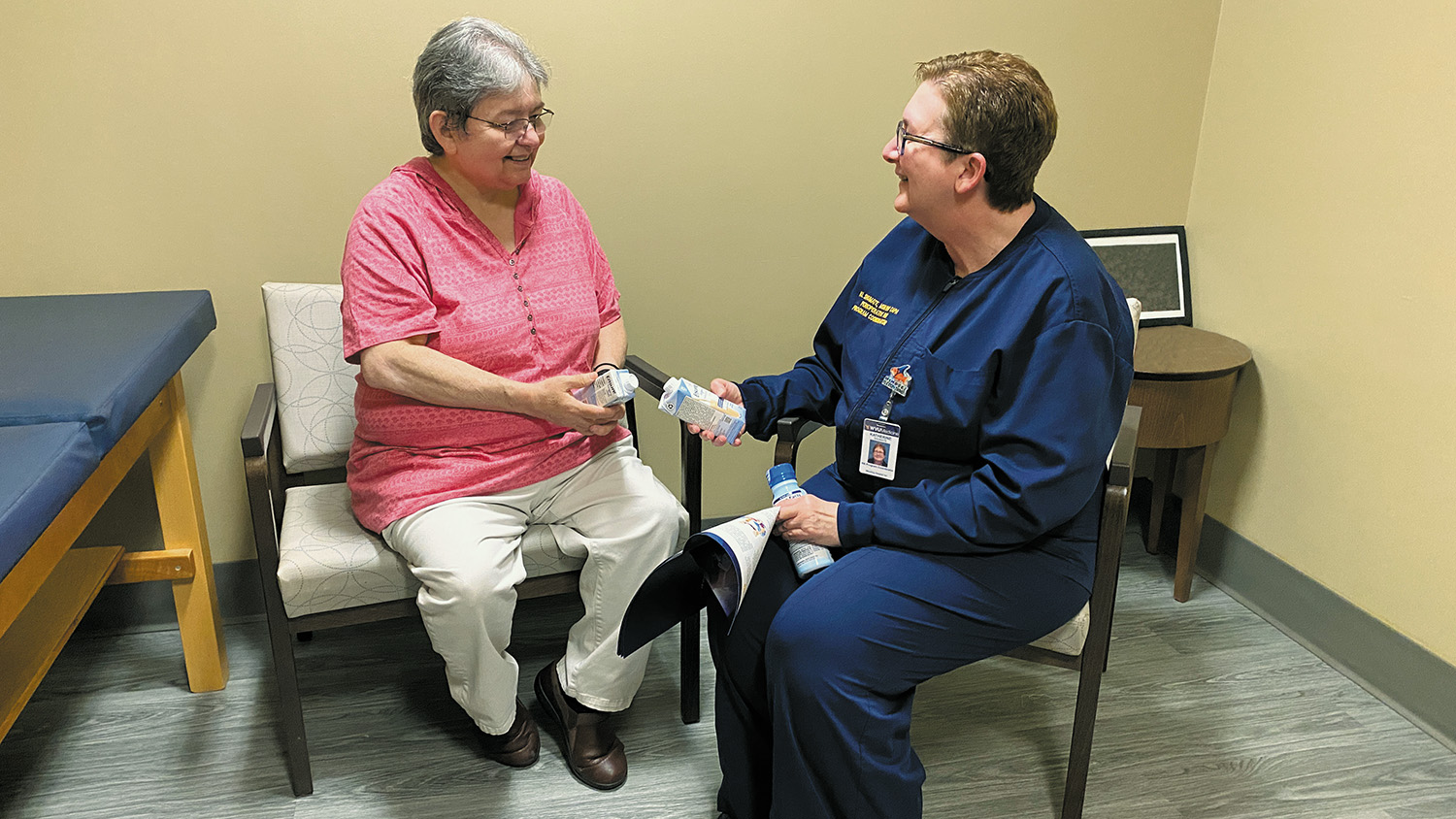
A vanilla-flavored nutritional drink that, according to what Kathy Shumate hears from patients, tastes pretty good poured over frozen berries or stirred up with a bit of peanut butter powder is helping to drastically improve outcomes among surgical patients in West Virginia, especially those who are malnourished.
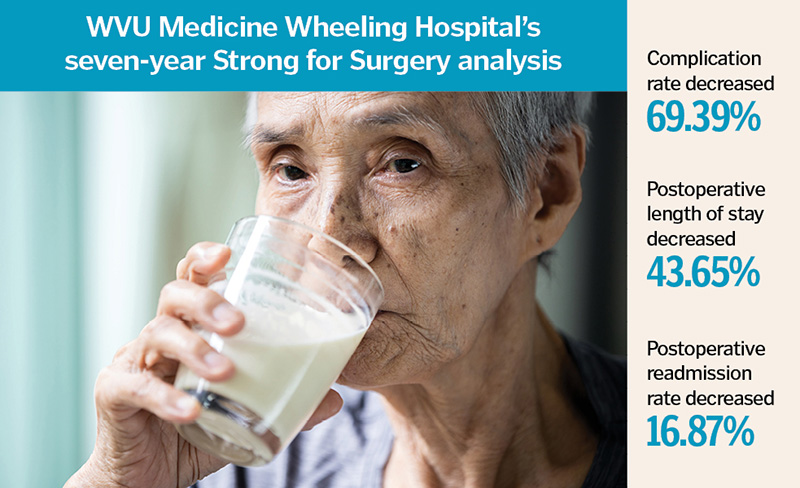
A seven-year study showed patients who underwent nutritional optimization before and after surgery at WVU Medicine Wheeling Hospital experienced a 43% decrease in time spent in the hospital, a nearly 17% decrease in readmissions, and a more than 69% decrease in complications, such as surgical site infections.
Patients get the drinks for free. The cost to the hospital is $52 per patient.
"I have an administrative team here who knows that little $52 per patient is absolutely nothing compared to a surgical site infection that's going to cost you on average $24,000," says Shumate, the perioperative registered nurse program coordinator at WVU Medicine Wheeling, who came up with the idea for the program. The administrators are supportive of any initiative that will improve patient outcomes, she says.
The hospital, founded in 1850, is one of the oldest in the country. It is the only Catholic hospital within the West Virginia University Medicine Health System. Since the nutrition program started at the Wheeling hospital in 2018, many of the system's 25 hospitals have established similar programs.
Challenges of rural care
The facilities are in Ohio, Pennsylvania, Maryland and West Virginia, all part of the Appalachian region, where the poverty level of 23.9% exceeds the national level of 11.5%, according to Worldmetrics.
In West Virginia, about two-thirds of the population lives in rural areas, and more than 90% live in medically underserved counties, according to the West Virginia Health Care Authority. The state is ranked the 46th least healthy and has the nation's fourth-highest poverty rate, according to the World Population Review.
Many rural patients are self-reliant and distrustful of health professionals, Shumate points out. Some are malnourished because it's difficult to access fresh healthy food. If they delay needed medical care, they may find it difficult to eat or may not have an appetite by the time they see a doctor, she says.
Malnourished patients are three times more likely to have a complication and five times more likely to die after surgery, Shumate says.
Shumate has spoken at international and national conferences about her work with Enhanced Recovery After Surgery, or ERAS, an evidence-based approach to care pre- and post-surgery shown to improve outcomes. She spoke at the 11th ERAS World Congress last fall in Turin, Italy, pointing out that proper nutrition, one of the elements of the approach, can be especially challenging because of limited access to healthy foods for the 40% of the world's people who live in rural areas. The congress drew 460 people from 30 countries. She was the only nurse at the gathering who spoke about her work.
How it started
Shumate has been a nurse for 42 years, most of that time in Wheeling and mostly in perioperative services. "When you get to be a nurse with that many years, you kind of get a feeling about patients who come in for surgery. Who's going to do well and who's not going to do well? You just get this intuition, and it's hard to explain that feeling to surgeons," she explains.
While the concepts for ERAS were first published about 30 years ago, the program at WVU Medicine Wheeling began in 2018. That year, several patients who came in for elective surgery gave Shumate pause. The hospital ethics committee gathered to help determine whether these patients were healthy enough to have their surgeries. That prompted Shumate to develop a two-minute frailty scoring system, assessing things like ambulation and nutrition. Many patients scored poorly.
In an effort to fix the problem and get patients strong enough for surgery, an anesthesiologist, Dr. Kenneth Nanners, introduced Shumate to the American College of Surgeons' Strong for Surgery initiative, which clinicians implemented at the Wheeling hospital. The initiative helps clinicians evaluate surgery readiness by looking at things like a patient's glycemic control for diabetes, whether the patient smokes, their home medications, and nutritional habits.
"The one thing that we determined that we can change is their nutritional status," Shumate says.
The hospital started with a small group of patients over age 65 who were getting elective intermediate or high-risk surgeries, such as a gallbladder removal or a colorectal surgery. The patients got nutritional drinks for about a week before and after surgery.
"We immediately noticed these improved outcomes, especially with surgical site infections wound healing," Shumate said. "This went on for a couple years. We just kept noticing results were just improving, improving, improving."
Expanding and adapting
The hospital expanded the program to patients 18 and older in 2023. During the pandemic, when nutritional drinks were in short supply, nurses noticed infection and complication rates started rising as patients stopped getting the drinks.
The system has changed drinks several times. Shumate has found that arginine, an amino acid that depletes when people's bodies are under stress, is a key nutrient. Now, the system uses special blends of Ensure- and Juven-branded immunonutritional and carbohydrate-loading drinks and shakes.
Getting patients to consume the drinks has been surprisingly successful, with 95% of patients reporting they drank all the products before surgery and 92% saying they consumed the drinks after. Each hospital provides the drinks and information sheets at preoperative checkups.
Shumate and the nurses ask patients to think of undergoing surgery as completing a 5K run. "You would not get up off your couch and go run a 5K without training," Shumate says. "Surgery is more stressful to the body than running a 5K. And so therefore, you would condition yourself. You would prepare to get up and go for that race. So, that's what we're doing for surgery. We are preparing you to be strong for surgery."

Leveling the field
Shumate says clinicians offer all pre-op patients in the program the drinks regardless of whether they are malnourished. The hospital can't screen everyone for nutrition, and appearance or weight alone wouldn't tell clinicians whether someone eats a healthy diet or not, she says.
"Just get everybody on the playing field, just get everybody treated the same," she says.
That's health equity, she points out. Patients who are malnourished also get a nutritional consult about their eating habits or to connect them to food resources, she says.
Part of being a Catholic hospital means treating the whole person and their family, and getting them in the best physical, mental and spiritual state to face their surgery, Shumate says.
Shumate learned that only 30%-40% of hospitals have a formal perioperative nutrition program, and she advises those who want one to start small and figure out the population they want to assist. For example, the Wheeling hospital wanted to inform surgeons whether patients were too frail to undergo elective surgery and reduce the complication rate.
"This truly did start as a performance improvement project in the basement of the hospital," she says.
The program has spread throughout the WVU Medicine system, with different hospitals adding it for different populations having various surgeries. Shumate wants to add nutritional drink programs for patients undergoing nonelective surgeries. Last fall, the system started one for patients with hip fractures who need to undergo surgery quickly. Clinicians already see good results in those patients who get nutritional drinks after the surgery as they heal.
Every health system can help put patients on a level playing field, Shumate points out.
"Of all the things that we can do for patients, when it comes to the things that we can change and not change, nutrition is it," she says.