
Jennifer Bayersdorfer calls Caring Reliably, the approach to ensuring reliability and patient safety at Providence St. Joseph Health, a "cultural foundation."
"It is at the heart of what we do, and it helps to guide the ways that we show up and the ways that we interact and work together," says Bayersdorfer, senior vice president and chief quality officer at the system.

Caring Reliably is in place across Providence, a system based in suburban Seattle that has 51 hospitals and hundreds of other care sites in seven Western states. The motto of the strategy is: "Be compassionate. Be safe. Be reliable." The strategy is grounded in principles such as teamwork, clear communication, mindfulness and a questioning attitude. It is meant to establish consistent expectations for how caregivers lead, communicate, escalate concerns and learn from harm events.
In short, Bayersdorfer says, the goal of Caring Reliably is to reach "zero preventable harm."
Knowing the risks
The approach to safety draws on the concept of "high reliability organizing" that was first put into practice by industries such as nuclear power and aviation, Bayersdorfer explains. Those industries operate in complex, high-risk environments, but experience relatively few accidents because they adhere to specific shared principles and practices.
"It sounds a little scary, preoccupation with failure, but a preoccupation with failure is about everyone understanding that mistakes can happen, that things can go wrong," Bayersdorfer says, "and to anticipate how they might go wrong, so that we can actually act to prevent those things from happening."
Another concept incorporated into Caring Reliably is a "sensitivity to operations." Bayersdorfer says that concept means everyone on a team is made aware of what is happening and what is ahead so they can be prepared to address any situation that arises.
One way Providence maintains that situational awareness is through tiered huddles. When an issue arises, teams first connect at the level where care is being provided. Any conditions or issues that remain unresolved or need further attention move up to be reviewed. The resulting huddles can escalate as high as the system level.
"It's a way for us on a day-to-day basis to know what are all the risks out there that we can be aware of and mitigating so that nothing goes awry," she explains.
Toolboxes
Bayersdorfer says Providence's embrace of the principles that eventually became Caring Reliably goes back about 12 years to when one of its legacy systems, Providence Health & Services, began working with a consultant focused on health care performance improvement. When that system merged with St. Joseph Health in 2016, Caring Reliably was being phased in and was carried over.
Two toolboxes created by Providence contain the basics of implementing Caring Reliably. One is for all workers, and one is for all leaders. This year, the system is crafting a third toolbox specific to executive leaders.
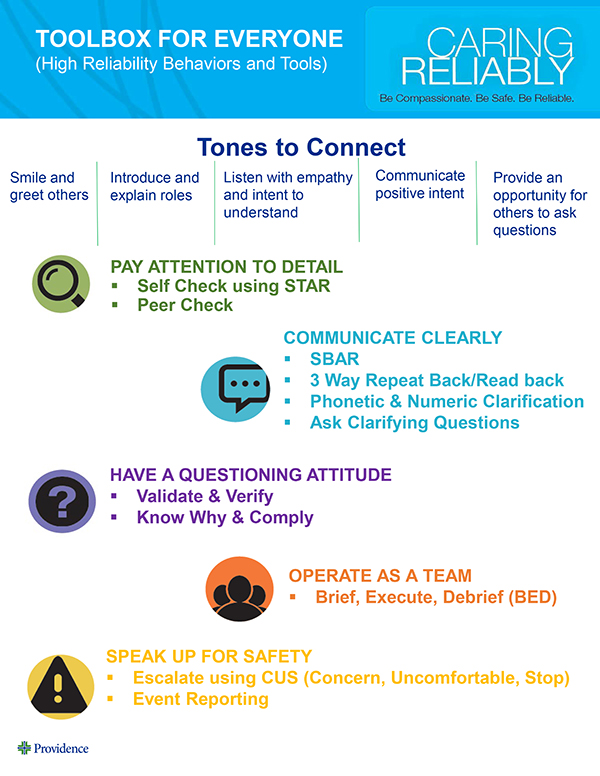
A core principle in the toolboxes is reducing what Bayersdorfer calls the "power gradient" so that a Providence staffer at any level feels empowered to voice a concern without fear of reprisal. "It's really creating the psychological safety of all members of the team to speak up for safety," she explains.
A one-pager on the Caring Reliably Toolbox for Everyone covers "tones," or communication practices, to help teams connect with each other and caregivers connect with patients:
- Smile and greet others
- Introduce and explain roles
- Listen with empathy and intent to understand
- Communicate positive intent
- Provide an opportunity for others to ask questions
"They're intended not just to deliver a consistent experience to, say, our patients, but it's also to sort of set the tone of, how do we show up with one another," Bayersdorfer explains. "And it helps us build trust and it reinforces respect for one another."
- Pay attention to detail
- Communicate clearly
- Have a questioning attitude
- Operate as a team
- Speak up for safety
A workbook for the toolbox explains the logic and intention behind Caring Reliably and goes into how to best put each tone and behavior into practice. For example, in the questioning attitude section there is a CUS tool, an acronym for language that staff can use to signal concern and, if needed, escalate intensity. The related words are: I'm concerned. I'm uncomfortable. Stop.
When those words are spoken, Bayersdorfer says, it's a red flag that the team should pause and hear the speaker out. "Usually, 99.99% of the time, they don't have to get any further than saying they're concerned or uncomfortable before the situation gets the resolution that it needs," she says.
Bayersdorfer says Providence has simplified the Caring Reliably toolbox for leaders over time to focus on three "methods" or pillars for leaders to uphold:
- Create psychological safety by fostering a working atmosphere where staffers are encouraged to ask questions and recognized for doing so
- Lead reliable operations with situational awareness using tactics such as huddles and other techniques within the huddles to rapidly resolve and even head off problems or issues
- Guide local learning systems by actively inviting the teams to bubble up the ideas that they have for making their work better, to resolve issues that might affect their ability to do a good job, and to be a part of those solutions
New Providence hires get training on the basics of Caring Reliably. The system also has an active "champion community" that touts the approach internally. Also, Providence highlights specific Caring Reliably tools and behaviors each month in all-staff communications and in huddles.
"The tools — all of it — are relevant to every member of our team, regardless of whether they're providing direct care, or whether they're three degrees separate from the care that's being delivered," Bayersdorfer says.
Safe, compassionate, well-coordinated care
While Caring Reliably does set out a foundation, Bayersdorfer says Providence's individual ministries have leeway on how to implement it and communicate about it in line with the unique aspects of the communities they serve. For example, Kadlec Regional Medical Center, a Providence-affiliated hospital in the central Washington city of Richland, crafted a word game for staff to get the concepts of Caring Reliably across during Patient Safety Awareness Week in March.
A partner to Providence in Caring Reliably is Press Ganey, a company well known for its surveys of patient experience and employee engagement. Providence uses Press Ganey's Human Experience Platform, which relies on survey findings, event reporting and other metrics, to connect safety data to daily practice and reinforce reliability across teams and disciplines.
Bayersdorfer says those metrics require long-term monitoring, so it's too soon to identify trends across Providence. "But what I will say is, especially at local levels, where we have a little bit more control around the data, we've seen many of our ministries with sustained improvements in these areas over time," she notes.
The tones, tools and behaviors of Caring Reliably influence the way care is delivered across Providence, she says, through practices such as clear communication, openness to questions, and coordinated teamwork.
"The outcome should be safe, compassionate, well-coordinated care centered around the needs of the patient," Bayersdorfer says.