
They could see the prospect for bringing better care to more people with more efficiency but also the hurdles. In addition to the logistics of uniting the two systems, such as combining their finances, medical records and human resources as well as those of their subsystems, decisions had to be made about where its headquarters would be based, how its mission statement would be worded and much more.
Ali Santore, who was leading government affairs for Providence Health & Services at the time it joined St. Joseph Health, recalls that the unification was far from simple. "But I think, overall, we did what we set out to do, and we're not done yet," says Santore, now the chief communication and external affairs officer for the combined system, Providence St. Joseph Health.

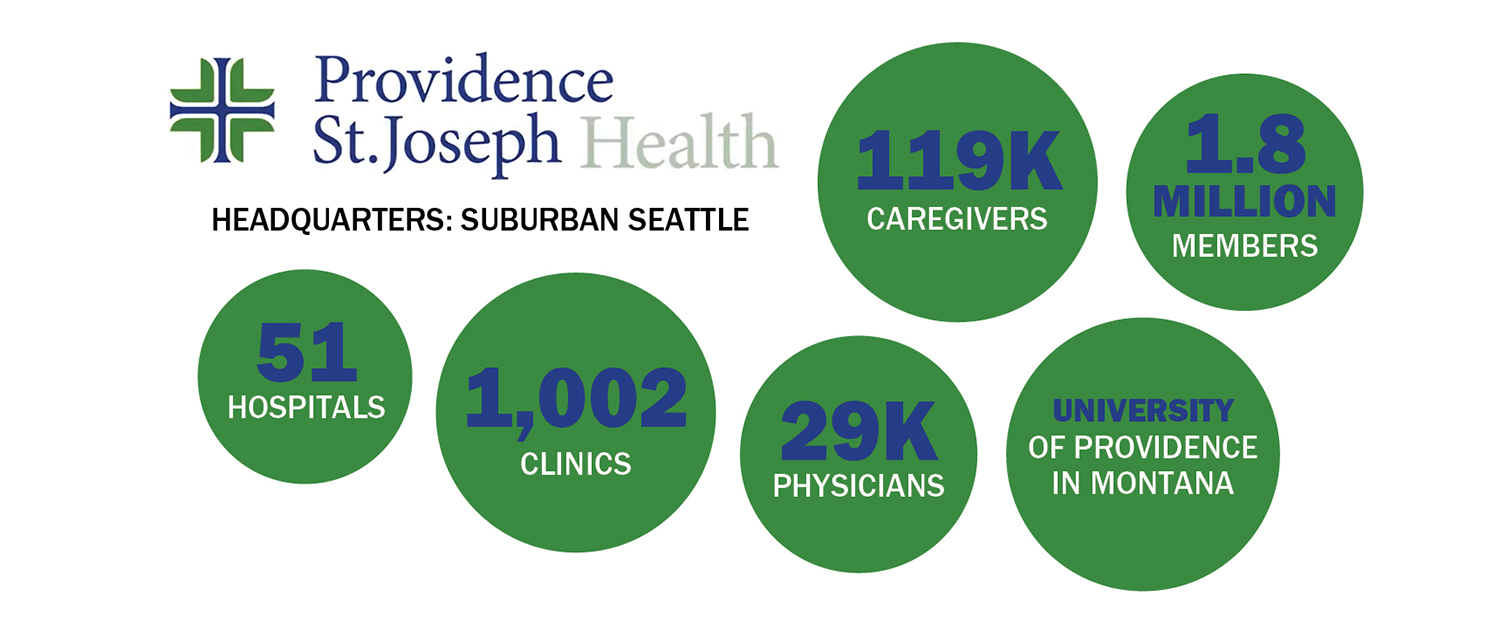
Since its 2016 founding, Providence, as the system is commonly known, has deepened the footprint of its legacy systems in seven western states: Alaska, California, Montana, New Mexico, Oregon, Texas and Washington. It added one hospital, bringing the total to 51, as well as dozens of new clinics, expanding a network that is now at about 1,000. It has developed a telehealth network that digitally connects 20,000 care providers. The Providence workforce numbers about 119,000. Patient visits are at 29.8 million annually. Last year, Providence provided $2.1 billion in community benefit.
Santore and Sr. Katherine "Kit" Gray, CSJ, who was on the ministerial public juridic person that sponsored St. Joseph Health and on the original sponsors council for the new system, credit the commitment to discernment of both legacy systems for the success of their union.
Sr. Gray says the groundwork for that process had been laid long before talks about the systems coming together began because discernment was inherent in the culture of the legacy systems' founders: the Sisters of Providence and the Sisters of St. Joseph of Orange.
"The process of thoughtful, reflective discernment is something both communities brought to the decision to come together," Sr. Gray says.
Blending Two Legacy Systems
Santore and Sr. Gray say what had been distinctions of the legacy systems are now part of the blended system. For example, Santore says the phrase "sacred encounter" wasn't familiar to her until her new colleagues from St. Joseph Health introduced it. It was how they referenced interactions among caregivers and between caregivers and patients. "If you were to come to Providence St. Joseph Health now and you use the term sacred encounter, it's just part of our shared culture," Santore says.
Providence's mission, values and promise statement also reflects the shared legacy. That guiding language came together after what Sr. Gray says was a year of discernment that engaged 90% of the staff through focus groups and listening sessions.
"We were looking for similarities, kind of things that already fit together, and at the same time, we were looking for new language," Sr. Gray says.
Some of the values are ones to which both systems had already pledged, such as justice and integrity. But the statement includes phrases that had been associated with just one, such as the promise: "Know me, care for me, ease my way," which came from Providence Health & Services. And part of the newer language is the vision: "Health for a better world."
That mission statement has endured. "I've heard no whispers of changing it, none at all," Sr. Gray says.
Explaining the "Why"
Like the mission statement, the governance framework set up at the time the legacy systems united has held. One board of directors oversees Providence. The system's South division has its own oversight board and Sr. Gray is a board member. More than three dozen local boards oversee service areas within Providence. The sponsors council for Providence continues to include five members each from the legacy systems, some lay and some consecrated religious.
In her role at the start of Providence, Santore helped shepherd the union through the regulatory process in California. That included hosting more than a dozen public hearings in communities where the legacy systems had hospitals to explain the "why" behind the pending partnership to the public and to staff.
"It's been really exciting for me to see what we talked about in those hearings, the vision for what this ministry would be and how we could have a greater impact on those we serve, come to fruition," Santore says.
One of the programs that embodies the commitment Providence made at its start to improve the health of the communities it serves is the Well Being Trust. That foundation describes itself as "dedicated to advancing the mental, social, and spiritual health for all."
Providence seeded the foundation, initially called the Institute for Mental Health and Wellness, with $100 million. Santore says it was the new system's effort to address the need for mental health care, which showed up repeatedly in community health needs assessments. Since its founding, the trust has funded programs and joined partnerships that have touched 1 million lives, Santore says.
One example of its impact is the initial $1.2 million that the trust provided to establish Waterfront Recovery Services, a substance abuse treatment center in Eureka, California. "We were able to bring resources through the Well Being Trust that otherwise would not have been there," Santore says.
Pioneering Spirit Endures
Another highlight of Providence's first decades is running a Medicare shared savings program that Santore says is one of the nation's largest and most successful. For 2024, the system says the program, in which the system works with providers to coordinate care, generated more than $177 million in savings for the Center for Medicare and Medicaid Services.
Another success has come from Providence's environmental stewardship efforts. Across 1,000 facilities that encompass 44 million square feet of real estate, Santore says, the system has decreased its carbon footprint, or its output of harmful greenhouse gas emissions, by 27%. "We have over 100 sites running on 100% renewable energy, including all of our sites in Texas," she notes.
Sr. Gray says both of Providence's legacy systems shared a "pioneering spirit." Well before the two combined, their sponsor councils met to support one another and discuss such topics as how to extend healthcare deeper into communities, improve access and accelerate innovation, all while remaining faithful to their charisms.
Even with that history of communication and support, she admits, the actual unification wasn't simple. For example, each system had leaders with the same job description, and the new system only needed one, so some top jobs were lost and some people lost their positions. Similarly, the systems were on different electronic records systems and to combine them meant merging them into one. "It's just darn hard bringing two complex organizations together and two cultures together," Sr. Gray says.
Living, Expanding the Mission
In the end, the union has succeeded. The leadership team came together. Dr. Rod Hochman, who was president and CEO of Providence Health & Services, stepped into the same roles in the combined system. He stayed in those roles through 2024 and continues to hold the system title of CEO emeritus. His successor, Erik Wexler, has been with Providence since it was formed.
Providence combined its medical records in 2018 in what was the single largest single implementation of the Epic system.
As Providence marks a decade of success, Santore acknowledges that, like healthcare systems across the country, it is facing strong headwinds. Some are coming from the Medicaid funding cuts and changes that are phasing in. Providence projects a loss of $1 billion in Medicaid funding over time. The system is looking at how to sustain itself and maintain services.
Santore says the revenue loss might mean the system has to adjust, as it did with its planned sale of Queen of the Valley Medical Center in Napa, California, to another nonprofit system. She says Providence discerned that the hospital would be better able to serve the community under the other system.
"Our founding congregations and sisters, they had to have that same discernment and evaluation through their times in stewarding the ministry," Santore says. "It's taken a great deal of humility and courage to recognize that in some very rare cases our ministries might thrive in the hands of others."
Looking ahead, Sr. Gray hopes that in its next 10 years Providence continues to provide care that promotes human flourishing. "I want us to be able to say that we have lived the mission," she says.
Santore says her hope is that "we have extended our mission to more people and made a continued impact, and that the health status of the communities that we serve is better because Providence St. Joseph Health was there."